The Fire Inside
A Father's Day Reflection on Multiple Sclerosis

(Originally published via the National Multiple Sclerosis Society)
It’s 2 a.m. in 2006. I’m a newly minted 29-year-old dad, rocking my one-month-old son Brady to sleep. The room is pitch black, broken only by the classic Winnie the Pooh nightlight dimmed to a barely-there dreamsicle orange. All is right in the world. Until I catch what appears to be an out-of-the-blue spark from the outlet near his crib.
Competing parental instincts find me torn between jumping abruptly out of the glider and keeping absolutely still so as not to wake the baby. I compromise, simply staring down the suspicious outlet for a few seconds. Sleep deprived, and probably seeing things, I close my eyes to nod off. Concerningly, the sparks intensify behind my eyelids.
That fire isn’t in the outlet. It’s in me.
That episode turned out to be optic neuritis, inflammation of my optic nerve, first misdiagnosed as a scratched cornea, then treated with steroids and a recommendation to come back if I ever experienced something like that again.
Life moved on. My vision returned, and Barb and I watched our family grow from 3 to 4 to 5, and a full decade passed in a movie montage of birthdays, baptisms and BBQs. The days so long. The years so, so short.
Then, in 2017, out of the blue, the departures screen at Charlotte Douglas airport caught fire.
My neurologist, Grace Cheng, was a gem: “You didn’t catch MS today,” she told me. “We’ve simply put a name to something that’s long been part of you.”
She asked whether I’d frequently felt fatigue. “Absolutely. First to leave the party.” Had I ever had a penchant for nonlinear thinking? I yell-laughed. “Doc, I’ve made a career out of it.”
I appreciated her sharing the science, but my first thoughts were not especially clinical. They were paternal. Looking at my 3 kids (then 10, 7 and 5), I found little solace in her explanations. I was squarely focused on my family: Would I die? Would I be able to work? What kind of dad was I going to be if my own wiring had turned against me?
A Changing Concept of Fatherhood
As a father, I think of myself as a provider. Materially, sure, but also of lessons, values and models my kids can emulate. Early after my diagnosis, suddenly and viscerally aware of my MS fatigue, I figured it was my job to man up and work through it, to show my condition (and kids) who’s boss.
But as I’ve gotten more acclimated to my condition, I’ve started to realize that dogged competition against my own biology isn’t necessarily the right life lesson.
For a while, I was measuring fatherhood with the wrong ruler. I’d picked up the idea that a good dad is tireless: always on, always available, strong in the obvious ways, the kind of fella who can white-knuckle his way through anything and call it character.
I’m not sure I believe that anymore.
Instead, I’ve come to believe that the lives best lived are more about creation than competition. And over the nine years since my diagnosis, I’ve gotten into a rhythm that’s more about working with my MS than against it.
For starters, I’ve parlayed my nonlinear thinking into a career as a futurist, connecting dots between disciplines in non-obvious ways. Is this, to a degree, augmented by my own synaptic signals having to make unexpected left turns at Albuquerque around sclerotic plaques? Maybe.
I’ve also recently become an entrepreneur, realizing that my tendency to burn brightly but briefly lends itself better to a life as an author and public speaker than it does to being a management consulting road-warrior. I tell my family I’m like an iPhone with a broken battery: fine when I’m charged, but draining to yellow faster than most and occasionally threatening to power down entirely without notice.
Most of all, I’m trying to get better at using those hours when I do have a green battery to be present with my kids.
Clichés around quality time versus quantity time might cause eyes to roll, but the older I’ve gotten, the more I’ve realized that clichés are clichés for a reason. When your body occasionally reminds you that nothing is guaranteed, the small moments stop feeling small. They become the whole thing.
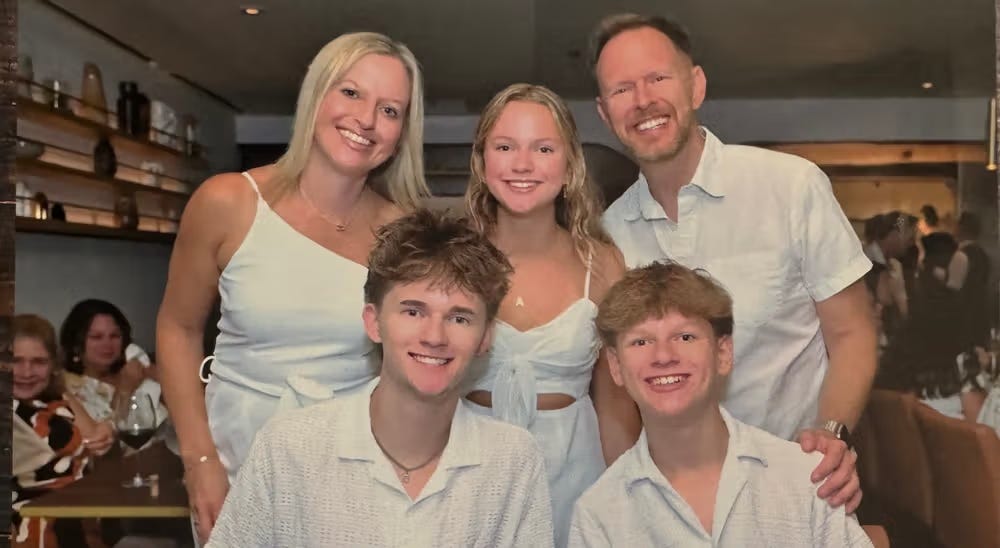
My 16-year-old daughter Annabelle recently said to me, “Dad, I’m not used to being able to have ice cream with you on a weeknight. I like it.”
That one got me.
So did a note Brady left on one of my social media posts. That same sleeping baby from the start of this story, now a 20-year-old sophomore at the University of Kansas. His comment was short and to the point:
”Hardest worker I know.”
You don’t expect to ugly cry when you’re reading LinkedIn comments. But there I was.
Not because I equate self-worth or family worth with work alone, but because Brady said it authentically and unprompted, and without reference to my condition. In that tiny sentence, he allayed a central fear I’d stoically carried for most of the last 20 years: that I couldn’t cut it.
These days, I’m less interested in modeling invincibility for my kids than honesty, adaptation and presence. I want them to know that their worth is not the same as their output. That rest is not weakness. That strength isn’t an absence (or disregard) of limits, but the willingness to live with them gracefully, and even gratefully. That when life gets weird, you can work with reality instead of wearing yourself out fighting it. And that a good life and legacy is built less by conquering everything in your path than by creating something meaningful with what you’ve been given.
It turns out that MS did not disqualify me from fatherhood. If anything, living with MS has made me a more mindful, present pops.
As a dad, that may be one of the most important things I have to pass along.
This is so heartwarming. Thank you for sharing. You've got one of the most difficult conditions and yet you live so vibrantly. Thanks for sharing your perspective as a father.